Eye health resources

How to read contact lens prescriptions

Find out what the words, abbreviations and numbers mean on your contact lens prescription. That way, when you get your next package of contacts, you’ll be able to confidently double check your box to make sure your prescription matches.

Medically reviewed by Dr. Giovanna Olivares, OD, FAAO
Published on August 21, 2024; Last updated on March 17, 2026
5 minute read time

Key takeaways

  • OD = right eye, OS = left eye
  • Power (PWR/SPH/D) tells how strong your prescription is
  • CYL and AXIS only apply if you have astigmatism
  • Positive numbers indicate farsightedness while negative numbers indicate nearsightedness

Why it’s important

Example of an eye exam prescription

When your eye doctor first hands you your contact lens prescription, it may look like a foreign language, but getting to know what all the numbers and abbreviations mean is important for two reasons.  

  1. It helps you understand your eyes, and how they work. 
  2. When your box of contact lenses shows up, it helps you double check that the lenses you received match your prescription. Do not use if there is a mismatch. 

What do all the abbreviations and numbers mean?

On the contact lens prescription above, you’ll notice some shorthand that eye doctors use to quickly communicate which lenses will correct your vision. In the next few sections, we’ll go over them one by one. 

The meaning of O.D. and O.S.

O.D. is short for oculus dexter, which is Latin for “right eye.” 

O.S. is short for oculus sinister, which is Latin for “left eye” (though we see nothing sinister about a left eye vs. a right eye). 

Prescription strength: Power (PWR), Sphere (SPH), or Diopters (D)

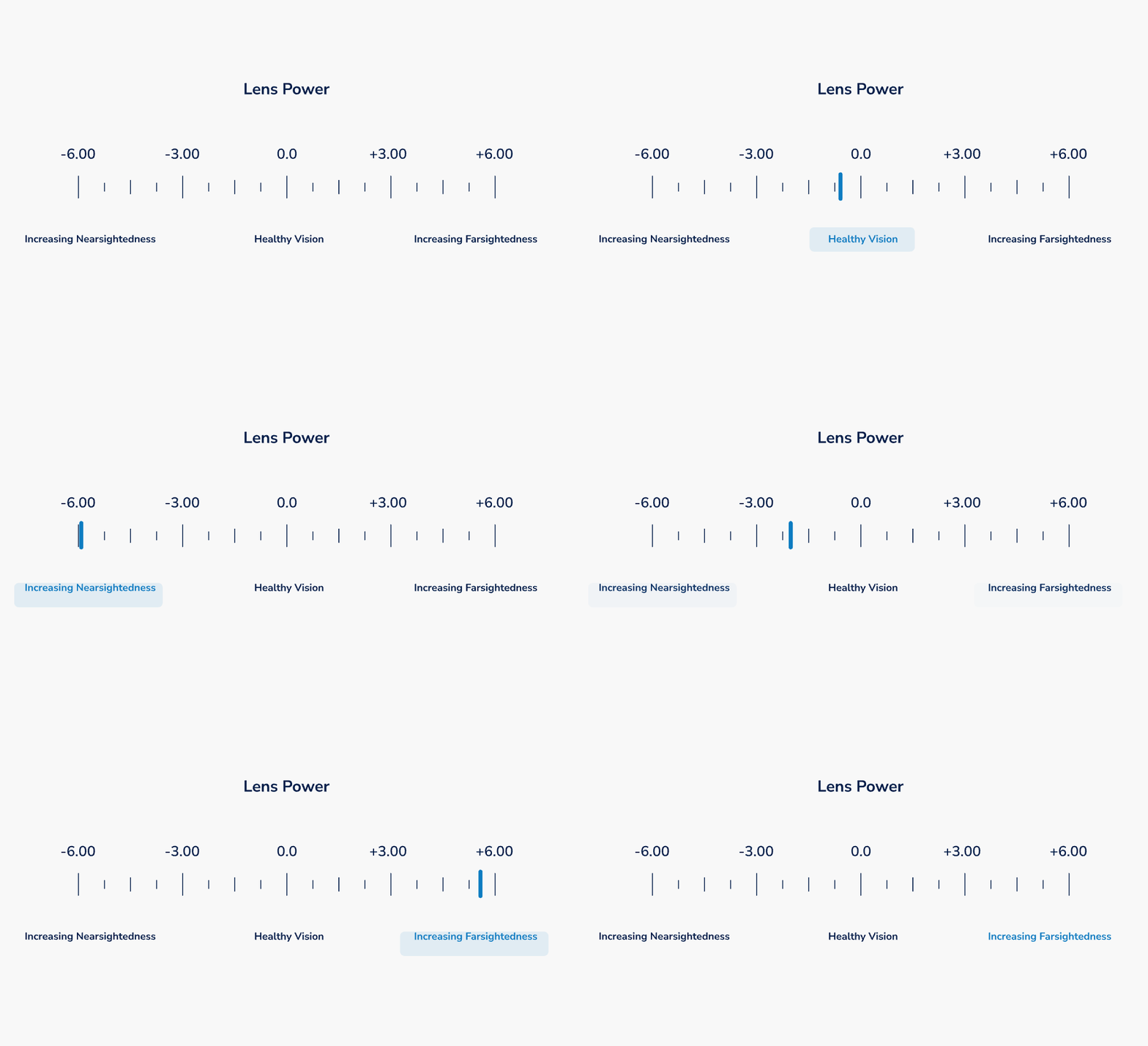
Gif showing lens power range

POWER, sometimes labeled as sphere, SPH, or D, is the power needed to correct your vision. 

  • Minus sign (–): Indicates nearsightedness (myopia).
  • Plus sign (+): Plus sign (+): Indicates farsightedness (hyperopia).
  • Diopters (D): The unit of measurement for lens power. The further the number is from zero, the stronger the prescription. These numbers typically move in steps of 0.25 (e.g., -1.25, -1.50). If you’re at a zero, it means  you need no correction. Your eye doctor may also write this as “plano” or PL, meaning no prescriptions is necessary. 

Prescriptions for presbyopia: ADD (Addition)

ADD, or additional lens power needed for reading, is included for people who have presbyopia. You may have noticed that many older people need to hold their phone or restaurant menu at arm’s length to read. This natural loss of the ability to focus or see things clearly up close is a normal part of aging and is corrected by the ADD.

Fitting the shape of your eye

BC, or base curve, is the curvature of your contact lenses. Measured in millimeters, it’s one of the factors that determines how well a lens fits your eye, because the lens is meant to fit your eye’s natural curvature.  

DIA, or diameter, is the width of your lenses, also measured in millimeters. This can impact how the contact lens sits on your eye and how much of your eye it covers.

Understanding prescriptions for astigmatism: CYL (cylinder) and axis

Astigmatism is when your eye is shaped more like a football than a basketball, meaning, rather than having only one curve to correct, you have two. This is why your contact lens prescription includes two extra numbers: CYL and AXIS. Each person’s level of astigmatism is a little different and requires vision correction that is unique to them. 


CYL, or cylinder, is a measurement of the severity of your astigmatism. It tells how much the shape of the eye is off. The bigger the number, the more correction that’s needed to give you clear vision.    


AXIS  is a measurement from 0-180 degrees telling where to place your astigmatism correction (where the uneven shape is located). If you don’t have astigmatism, your eye is perfectly round, and there is no need for orientation of your correction because the curve is the same in every direction, but with astigmatism, your correction needs to line up with the curves of your eye to work properly.    

The importance of the names and dates on your prescription

A contact lens prescription will have some information that isn’t just about your contact lens fit. For starters, your name. And with that fact, it’s a good time to drive home the point that a contact lens prescription is tailored to your eyes and your eyes only. Your contact lenses should never be shared with anyone else.


The two dates include the date your prescription was issued, and the expiration date of the prescription, which is typically a year later (and different than the expiration date of the contact lenses you’ll purchase).

How long is a contact lens prescription valid?

In the United States, the Fairness to Contact Lens Consumers Act sets a minimum expiration date of one year for contact lens prescriptions, unless there is a legitimate medical reason for a shorter duration. Some states may require longer validity periods.


Important: The expiration date on your prescription refers to how long the prescription itself is valid for purchasing lenses. This is different from the expiration date printed on a box of contacts, which indicates the shelf life of the sealed product. 

How to get a contact lens prescription

An eye doctor performing a vision test with a tonometer in her office

You’ll need to schedule a contact lens fitting appointment. After your appointment, you’ll probably go home with some free trial lenses to try. You’ll typically go back to see the eye doctor after a few days to have the vision, comfort and fit on your eye verified. Then you’ll be given your contact lens prescription.

More questions about your contact lenses? We’re here to assist.

Get help from the comfort of your home with MyACUVUE®. Our new troubleshooter tool for new contact lens wearers helps guide you through common contact lens challenges.

Mobile preview of MyACUVUE screens displaying the LensAssist troubleshooter questions and recommendations
FAQs

Frequently asked questions

Can you convert your glasses prescription to a contact lens prescription?

Since eye glasses sit away from your eyes and not on them like contact lenses, the prescription can be a little bit different. Additionally, glasses prescription will not provide the BC that is needed for the lens to fit on your eye correctly. You may be able to find conversion calculators online, but contact lenses are  medical devices, so you’ll need an eye doctor to write you a prescription specific to contact lenses.

What does +0.25 mean?

A sphere prescription of +0.25 means that you have very minor farsightedness. A cylinder prescription of +0.25 means that you have a very minor astigmatism.

What is power PWR/SPH?

PWR (Power) or SPH (Sphere) is a measurement that tells you how strong your contact lenses or glasses need to be to help you see clearly. A “plus” number (+) means it helps with farsightedness, and a “minus” number (-) helps with nearsightedness.

How much weaker should contacts be than glasses?

It isn’t that contact lenses should be weaker than glasses, but that contact lenses sit on your eye rather than in eyeglass frames, meaning the prescription will be different. This is why you can’t directly convert an eyeglass prescription into a contact lens prescription.

Is 0.25 astigmatism a lot?

Since prescriptions are measuring in increments of 0.25, this is the lowest level of astigmatism a person can have. In fact, most people have this level of astigmatism or more.

What does BC mean for contacts?

When referring to contact lens prescriptions, BC stands for Base Curve, or the curvature of your contact lens. Depending on the shape of your eye, certain base curves may fit better than others.

How bad is my astigmatism?

It’s important to talk to your eye doctor to understand the severity of your astigmatism. Generally speaking, cylinder prescriptions -2.50 and above are considered high or severe myopia. This level of astigmatism can cause significantly blurred or distorted vision.

Related content

An eye doctor performing a vision test with a phoropter

How to get contacts

Image of a smiling doctor speaking to a woman with wavy hair

What to expect at your first contact lens exam

Always thoroughly wash and dry your hands prior to handling your contact lenses. 

The information provided on this page and across the entire Acuvue.com experience is designed to offer educational insights into eye health, referencing expert advice from reputable medical and government organizations, including the American Academy of Ophthalmology, the American Optometric Association and the National Eye Institute. While we research, report, and review the content on Acuvue.com and its extended social media to deliver accurate and up-to-date vision, vision care, and vision correction information, we do not make any assurances, and content accessed on or through Acuvue.com and its extended social media is not intended to replace professional medical advice, diagnosis, or treatment of any eye conditions or health issues. This brings us to our #1 eye health tip: Always consult a qualified healthcare professional for personalized medical guidance and care.

2026PP04482
ACUVUE navy logo in capital letters
We support the AdvaMed Code of Ethics on interacting with Healthcare Professionals.
Advamed Logo
© Johnson & Johnson and its affiliates 2026. All rights reserved. This site is published by Johnson & Johnson Vision Care, Inc., which is solely responsible for its content. It is intended for use by residents of the United States.

Third-party trademarks used herein are trademarks of their respective owners.